
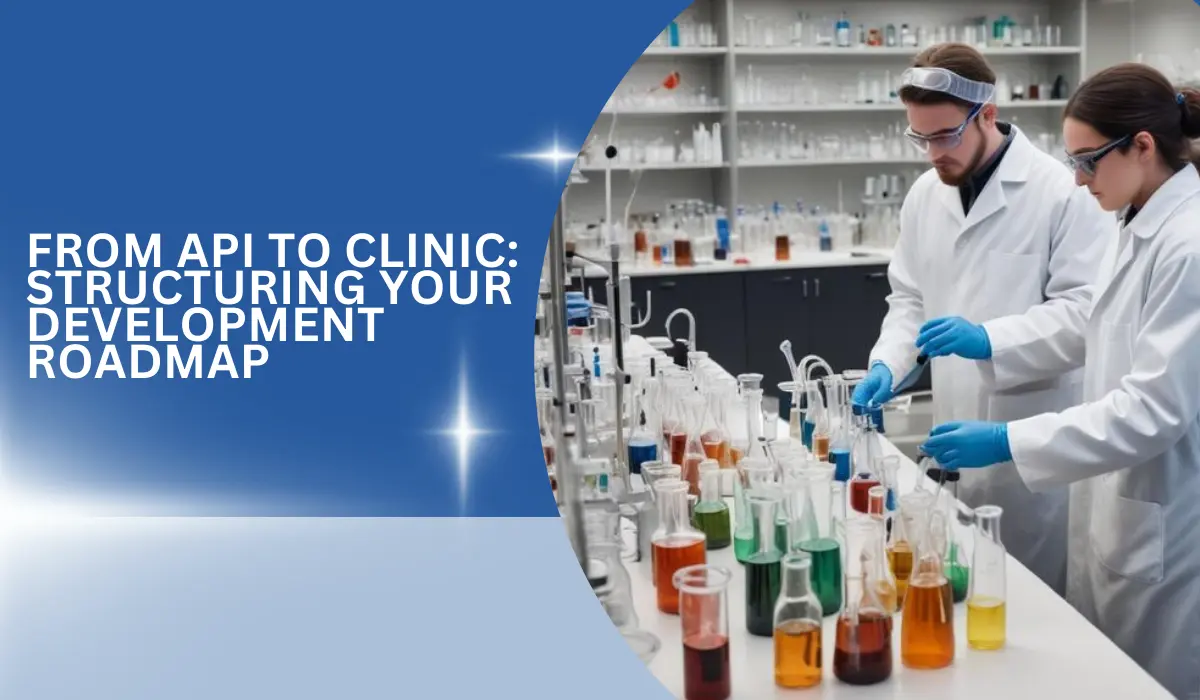
The journey from creating an active pharmaceutical ingredient (API) to administering the first human dose is one of the most resource-intensive and strategically critical phases in drug development. While science drives innovation, planning drives success. Hence, the need for an effective roadmap.
Accelerated pharmaceutical development has become a new norm in our industry. We often see biotech aiming to enter clinical development in less than twelve months from the development candidate nomination.
The compressed timeline is not the only challenge. Active pharmaceutical ingredients have become heavier, requiring longer and more complex synthesis to produce them, and are less soluble. The result: new variants often require solubility-enhancing formulation applications.
In 2025, global regulatory authorities expect more integrated development strategies. The FDA emphasizes that sponsors should “provide adequate information to assure the proper identification, quality, purity, and strength of the investigational drug” during early development (FDA CMC Guidance). This requires a roadmap that aligns API chemistry, manufacturing processes, and clinical supply readiness with your regulatory milestones.

Understanding the API-to-Clinic Lifecycle
Moving from API to clinic typically involves six interlinked stages:
- API Discovery & Initial Synthesis – Lab-scale creation of the drug’s active ingredient.
- Process Development & Scale-Up – Moving from gram to kilogram quantities with reproducibility.
- Analytical Method Development – Establishing validated testing methods for identity, purity, potency.
- Formulation Development – Converting API into a stable, deliverable drug product.
- Preclinical Manufacturing & Supply – Producing material for toxicology and stability studies.
- Clinical Trial Material Manufacturing – Scaling under GMP to support Phase 1 trials.
Each stage overlaps—decisions in early chemistry directly affect formulation choices, stability profiles, and even your clinical dosing strategy.
Building a Development Roadmap: Key Principles
Start with the End in Mind
Your roadmap should be built backwards from your first-in-human (FIH) trial start date. Work in reverse to set milestone deadlines for IND submission, stability data generation, GMP manufacturing, and preclinical supply.
Integrate CMC Early
Chemistry, Manufacturing, and Controls (CMC) planning should begin in parallel with preclinical studies. Early input from CMC experts reduces the risk of delays due to manufacturing or formulation challenges.
Establish Clear Decision Gates
Define go/no-go criteria for each stage—such as achieving a reproducible synthetic process or passing stability targets—before advancing to the next phase.
For more on aligning CMC with your development timeline, see SCx CMC’s strategic planning resources.
Stage-by-Stage Roadmap Guidance
Stage 1: API Discovery & Initial Synthesis
- Objective: Confirm feasibility of synthesis and generate small quantities for initial profiling.
- Actions:
- Select synthetic route with scalability in mind.
- Identify potential impurities and degradation pathways.
- Begin preliminary characterization (melting point, solubility, pKa, logP).
Stage 2: Process Development & Scale-Up
- Objective: Move from lab to pilot scale with consistent yields and quality.
- Actions:
- Optimize reaction conditions for reproducibility.
- Establish impurity control strategy.
- Identify critical process parameters (CPPs).
- Tip: Engage analytical chemistry early to monitor in-process controls.
Stage 3: Analytical Method Development
- Objective: Create robust, validated methods to support quality control.
- Actions:
- Develop methods for identity, purity, potency, residual solvents.
- Qualify methods per ICH Q2 guidelines.
- Prepare reference standards.
Stage 4: Formulation Development
- Objective: Create a drug product that delivers the API safely and effectively.
- Actions:
- Screen excipients for compatibility.
- Develop prototype formulations for stability studies.
- Conduct preliminary bioavailability assessments.
Stage 5: Preclinical Manufacturing & Supply
- Objective: Provide material for GLP toxicology and stability studies.
- Actions:
- Manufacture non-GMP batches sufficient for preclinical requirements.
- Begin stability studies under ICH conditions.
- Document batch records and analytical results.
Stage 6: GMP Clinical Trial Manufacturing
- Objective: Produce Phase 1 clinical trial material under GMP.
- Actions:
- Transfer process to GMP facility.
- Manufacture and release clinical lots.
- Package and label per clinical protocol requirements.
- Validate shipping and storage conditions (cold chain if applicable).
Regulatory Alignment Along the Roadmap
Your roadmap should align with key regulatory touchpoints:
- Pre-IND Meeting – Present API and drug product development plans to FDA for feedback.
- IND Submission – Include complete CMC section with drug substance and drug product information, manufacturing process descriptions, and stability data.
- Ongoing Updates – Submit amendments as manufacturing changes occur or new stability data becomes available.
By building CMC milestones into your roadmap, you avoid last-minute scrambles that delay IND clearance.
Risk Management and Contingency Planning
Even the best plans encounter challenges—unexpected impurities, scale-up failures, or supply chain disruptions. Your roadmap should include:
- Alternate Synthetic Routes – In case of yield or impurity issues.
- Backup Suppliers – For key raw materials and excipients.
- Comparability Protocols – To support post-change regulatory compliance.
Common Roadmap Mistakes to Avoid
- Ignoring Scalability Early – Lab-only processes often fail in pilot or commercial scale.
- Delaying Stability Studies – Early data supports both formulation and packaging decisions.
- Underestimating Regulatory Timelines – FDA feedback cycles can take months.
- Fragmented Communication – Chemistry, manufacturing, and regulatory teams must share data continuously.
Bring in an expert. As development progresses, regulatory and technical demands become more complex. You’ll need to account for designating starting materials, setting phase-appropriate specifications, managing nitrosamine and mutagenic impurity controls, and assessing process criticality. These skill sets are highly specialized.
While most biotech startups don’t need them indefinitely, they become critical at this stage.SCx consultants bring deep experience preparing INDs, IMPDs, and NDAs, which is why we recommend our clients engage them here. For organizations sourcing expertise on their own, it can be difficult to find individuals with comparable experience—especially those who have worked directly with FDA, EMA, PMDA, and other health authorities. A high level of regulatory fluency can make the difference between stalled progress and steady momentum.
Sample 12 Month API-to-Clinic Timeline
Once the development candidate is nominated the API work goes into hyperdrive and the journey to first-in-human clinical study begins. The steps that occur are roughly as follows:
|
Month |
Execution Time | Milestone |
| 1-2 | 2 month | API synthesis finalized and process optimize; phase-appropriate analytical methods and specifications ready |
| 3-5 | 3 months | API batch produced and start of GLP tox study |
| 3-5 | 3 months | Formulation and related analytical methods development (concurrently with API batch production) |
| 6-8 | 3 months | GMP API produced and start of stability |
| 9-10 | 2 months | GMP drug product produced and start of stability |
| 11 | 1 month | IND submitted with one month product stability data, wait one month to allow FDA to comment |
| 12 | 1 month | Begin dosing in the clinic |
How a CMC Expert Can Help Reduce IND Timelines
The base timeline for IND-enabling activities now averages about 12 months—but for many biotech startups, drug development timelines can easily stretch to 18, 22, or worse. That kind of delay can drain budgets and derail development plans.
That’s why we recommend placing a CMC expert with our clients at this stage. Their specialized perspective helps reduce the risk of timeline creep and, in many cases, identify opportunities to shorten development. Strong CMC strategy at this stage can mean setting phase-appropriate specifications for API and product, selecting the most optimal formulations, or streamlining CDMO selection through vetted partners and structured decision criteria. The more disciplined the IND process, the smoother the path into Phase 1 and beyond.
Conclusion: Roadmap as a Strategic Asset
Your API-to-clinic development roadmap is not just a project plan—it’s a strategic asset that guides resource allocation, mitigates risk, and ensures regulatory readiness. Sponsors who integrate CMC early, engage regulators proactively, and monitor against clearly defined milestones position themselves for faster, more predictable clinical entry.
As the regulatory landscape evolves in 2025, a disciplined roadmap will remain the most reliable tool for moving innovation from bench to bedside.
FAQ: From API to Clinic
Process scalability is a major risk—what works at lab scale may not work for GMP manufacturing.
Start as soon as you have a representative formulation to guide packaging and storage decisions.
Yes. Biologics have more complex manufacturing and characterization requirements due to their molecular complexity.
Yes. A pre-IND meeting allows you to confirm your development plan aligns with expectations.
Refer to the FDA CMC Guidance for the latest requirements.
One Response
Solid points all around.